|
|
|
|
|
Navajo-Churro: Americas First Sheep
By Connie Taylor Registrar and Breeder
|
|
Introduction
Americas first domestic sheep arrived over 400 years ago by the
Spanish explorers and settlers. The history of the churra importation
and distribution is fascinating and complex. Archives indicate
that Merinos were too valuable to export from Spain, so the common
sheep such as: Churra, Manchega, Castellana and Lacha were sent
to the New World. The term "Churro" is translated to mean "common"
and now refers loosely to all the breeds mentioned. Navajo-Churro,
derived from the original Spanish stock, are now widely distributed
in the U.S. with numbers approximately 6,000. Navajo-Churro are
considered a landrace breed that reproduces with high predictably.
History
Livestock, including sheep, came in 1494 when Spain established
colonies in the Caribbean and then in Mexico. Colonization expanded
gradually into Nuevo España which is now the Southwest of the
United States. In 1540, following the initial expedition of Cortez
in 1538, Coronado searched for the Cities of Gold expending 5,000
head of sheep on the journey. The few left in New Mexico were
not heard of again. Don Juan de Oñate, in 1598, brought settlers
and 2,900 sheep that formed the initial colonization of the Southwest.
Spanish ranches prospered in Texas, New Mexico and Arizona with
flocks numbering in the thousands. Many sheep were trailed back
to Mexico to feed mining towns and they supplied the growing population
of the Southwest. In 1849 when gold was discovered in California,
churros were trailed west to feed the Gold Fever.
During this period of Spanish colonization, Pueblo Indians were
hired and enslaved to herd livestock and to weave textiles. The
Dine (the Navajo people), living on the edge of Spanish occupation,
acquired a few sheep and horses by trades and by raids on outlying
settlements. Following the turmoil of 1680 when the Pueblos revolted
against Spanish oppression, the Navajos acquired more sheep, as
did the Apaches. The Apaches ate the sheep they took but the Navajos
nurtured their acquisitions and expanded their flocks.
As European settlers came west and the demand arose for fine wool
in the American textile industry, the churros were "graded up"
by crossing with Merino and English longwools. However, some churros
remained in the remote Hispanic villages, among the isolated Navajos
and on the West Coast. These isolated flocks eventually formed
the landrace sheep, the Navajo-Churro, named to recognize Spanish
and Navajo influence.
Because the Navajos resisted the settlers who were encroaching
on Dine homelands, the U.S. government ordered military actions
led by Kit Carson and John Carlton with instructions to destroy
Navajo orchards and flocks. There was much bloodshed and in 1865
approximately 9,000 Navajos were forced on the Long Walk of 300
miles to an interment camp at Bosque Redondo, New Mexico. Terrible
conditions here caused the death of many people and their livestock.
Some Navajos escaped capture and hid with their sheep in remote
canyons of New Mexico and Arizona. After three years, the Navajo
were returned to their homeland and were issued two "native" sheep
per person from Hispanic.flocks.
The Navajo were such good weavers and shepherds that their mixed
flocks grew to 574,821 sheep by l930. The large number of sheep,
goats, horses and cattle was problematic for the severe drought
conditions of the 1930s, so the U.S. government conducted a stock
reduction. Some stock was purchased for $1-1.50 but the reduction
progressed so slowly that roughly 30% of each households sheep,
goats and horses were slaughtered by government agents and thrown
into arroyos or burned. This terrifying Stock Reduction is still
vivid in Navajo memory.
Conservation
The Dine were initially responsible for saving the "old type"
sheep from extinction. Navajos successfully maintained original
flocks in isolated areas where no other sheep breeds were introduced.
Sheep meat, milk for yogurt and wool for textiles sustained the
Dine for centuries. Even today, "Sheep is life," is a strong
belief in traditional Navajos.
In 1934 the U.S. Department of Agriculture established the Southwestern
Sheep Breeding Laboratory at Ft. Wingate, New Mexico to determine
what sheep might thrive in that region. They assembled some "original
old-type" Navajo sheep from local flocks and for 30 years introduced
fine wool breeds and long wool breeds. They concluded that the
best wool for the weavers and the sheep most suitable for the
high desert were the "old type".
By 1977, the "old type" Navajo sheep had dwindled to less than
500 head so Dr. Lyle McNeal formed the Navajo Sheep Project to
revitalize this breed and keep it from further depletion. Through
the efforts of individuals such as Ingrid Painter, Dr. McNeal,
Antonio Manzanares, Maria Varela, Goldtooth Begay, Dr. Annie Dodge
Wauneka, Milton Bluehouse and Connie Taylor with the assistance
of conservancies such as the CS Fund and American Livestock Breed
Conservancy and Ganados del Valle, the Navajo-Churro Sheep Association
was formed in 1986. There are currently over 4,500 sheep registered
with the N-CSA, an estimated 1,500 on the Navajo Reservation and
several hundred undocumented sheep in the U.S., Canada and Mexico.
Breed standards were developed for conformation and wool characteristics
using historic records, oral descriptions from Navajo Elders,
the contemporary Spanish churra and research from the Ft.Wingate
project. This included objective measurements by USDA scientists
and subjective observations of the samplers woven and dyed by
Navajo weavers employed at Ft. Wingate. Individual breeders located
sheep sifted from the remnant flocks of the Southwest and West
Coast and a few sheep still existed at UC Davis in California.
"Wanted Posters" were used by Dr. McNeals Navajo Sheep Project
to increase awareness of the breed and to locate old type sheep
for a revitalization of the nearly extinct breed. Historic standards
were applied to the existing nucleus of all the "old type" sheep
that were located.
In 1986, the N-CSA began registering Navajo-Churro based on phenotype.
The registry process is vital to maintaining standards and providing
breeders a network of pedigree information. Even though standards
are used, there is an attempt to maintain the diversity within
this landrace population. Each sheep registered must be "seen"
and approved by on site inspection or by mail in photos and fleece
samples. All progeny must be inspected for registration, even
if parents are registered. The inspectors must have competence
in sheep and wool. Several on the team are university professors
or County Extension Agents who specialize in sheep. The flock
book remains open to all conforming sheep even if they lack pedigree
information.
Inbreeding is not a problem except in a few flocks. Committed
breeders pay attention and share transportation expense to long
haul stock. Genetic relationships for 2,845 sheep were calculated
by Harvey Blackburn, U.S.D.A. to calculate inbreeding levels for
individuals and for flocks. The average for the population was
3.8% in three generations and increasing. A few flocks had levels
of 10.5%. Breeders often refer to "A Conservation Breeding Handbook"
by ALBC for advice on sound breeding schemes for small populations.
Description
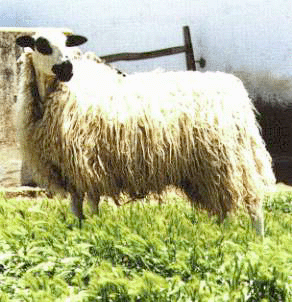
The Navajo-Churro sheep is a small, long tailed sheep with a double
coat of wool (80%) and hair (20%). The locks are long, tapered
and open. Rams weigh about 120-175 lbs. and ewes may weigh 90-120
lbs. Legs and faces of adults are clean.
Polled Scurs Two Horns Four Horns
Rams 11% 7% 50% 32%
Ewes 59% 9% 23% 09%
The sheep have strong flocking instincts and are very intelligent.
Lambing averages about 1.6 lambs per ewe per year if bred once.
Most Navajo-Churro are aseasonal breeders and mature early so
two lamb crops per year are likely if rams are left with ewes
year round. Ewes seldom require assistance of any kind at lambing.
Both ewe and lamb seem to know each other instantly. The lamb
suckles within 5-10 minutes and is ready to travel at the mothers
flank within that same short time.
Fleece
The fleece consisting of both wool and hair is highly variable.
Fleeces weigh from 4-8 lbs. and yield 67-72%. Hair can range from
6-8 inches while the wool is 3-6 inches. Many breeders shear twice
a year to avoid overly long fibers if they intend to commercially
process the wool. The fiber diameter has an extreme range of fine
wool at 18-30µ to hair at 30-47µ. Kemp fibers composing 2-5% of
the fleece is common and can be 60µ. Due to fiber migration, this
primitive fleece can cott if not shorn before hot summer weather.
Wool color is spectacular in the breed which manifests most of
the identified color patterns at the A locus. Navajo-Churro exhibit
solid color as a result of both Aa and also ED, so genetic color
identification is not always straightforward. The estimated color
percentages are based on registered sheep. Note that White and
Grey sheep that are born displaying much Tan/Red phaeomelanin
are separated for reporting but are considered part of the White
and Grey genotype. Both Badgerface and Black & Tan figures include
Black, Brown and Gray versions of these patterns. The Blue figure
may be under reported and includes English Blue and NSP Blue
| White 39% |
Grey/tan .6% |
| White/tan 5% |
Badgerface* 3.6% |
| Black 34% |
Black & Tan* 1.1% |
| Brown 9% |
Blue* <1% |
| Dark Brown 1.3% |
Piebald 2.7% |
| Gray 4.5% |
Mulitpattern 1.1% |
Current Developments
Slow Food, an international group dedicated to preserving traditional
heritage breed foods with exceptional taste, has recognized the
Navajo-Churro for its delicate flavor. Sheep can be butchered
at any age, but lamb from 6 months to nearly a year is considered
optimum. At 8-9 months, the hanging carcass weight is generally
47-52 lbs.
Genotyping has not been done on large numbers of Navajo-Churro,
but recent data indicates a higher percentage of RR types at Codon171
than for commercial breeds. The RR genotype is considered scrapie
resistant. Because the Navajo-Churro breed is classified as a
rare breed, the U.S.D.A. has begun collecting germplasm from Navajo-Churro
rams to cryopreserve in the National Seed Bank. Collection is
being done in collaboration with American Livestock Breed Conservancy
and Don Bixby, a long time champion of the Navajo-Churro.
Currently Navajo organizations, Dine be iina (who present the
annual Sheep is Life Celebration) and Black Mesa Weavers for Life
and Land are encouraging events that focus on the "old type sheep.
Tierra Wools, a Hispanic weaving business owned in common, has
successfully featured "Churro" wool for over twenty years. The
sheep is culturally and economically vital in these groups.
Because the Navajo-Churro is so colorful, so adaptable and produces
superb carpet wool, the limited population is highly prized by
U.S. sheep breeders and by artisans. The yarn is extremely durable
for use in rugs, saddle blankets, carrying bags and outer garments.
With the population hovering around 5,000, it seems the Navajo-Churro
has endured a close call with extinction and has endeared itself
to all of us who work with them.
This article first presented at the 2004 World Congress on Colored
Sheep in Christchurch, NZ.
|
|
Copyright © 2008. Navajo-Churro Sheep Association. All rights
reserved.
Contents of this site may not be used without the permission of
the Navajo-Churro Sheep Association.
|
|
|